
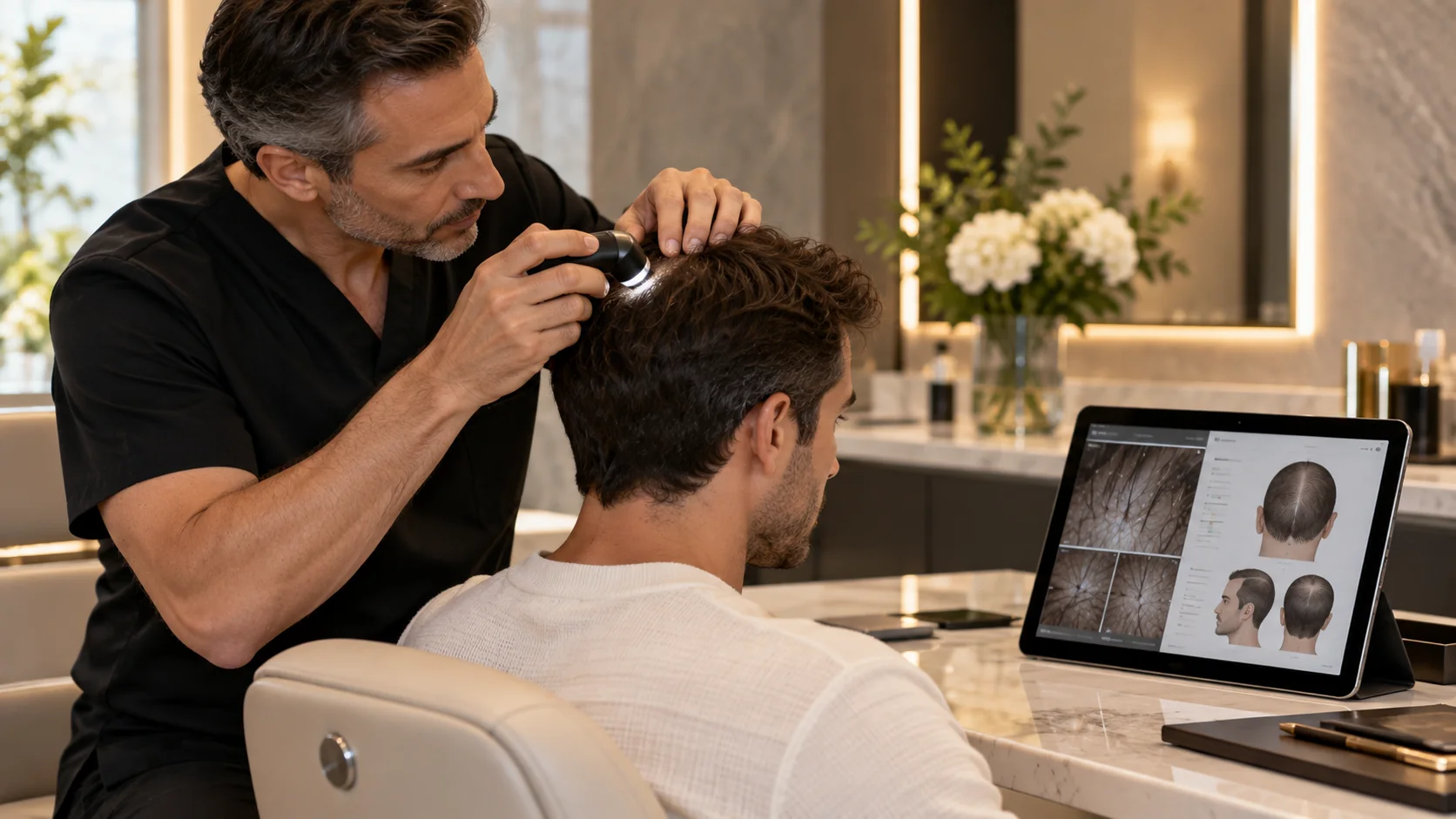
Noticing a receding hairline, thinner hair, reduced density or ongoing shedding can make a hair transplant seem like the obvious next step. Yet not all hair loss has the same cause, and not everyone who seeks advice is a suitable candidate for hair transplant surgery.
At BELA Salud y Belleza in Alicante, our starting point is simple: assess the hair and scalp before discussing a transplant. A hair assessment helps the team understand the pattern of loss, examine the donor area where relevant, and discuss whether medical care, surgery or another approach may be appropriate.
Hair loss does not automatically mean a transplant
There are many reasons why people may notice shedding or a change in hair density. Some are temporary, others follow a progressive pattern, and in certain situations a medical evaluation may be needed to explore possible contributing factors.
The initial consultation helps organise the information: when the problem began, how it has changed, any family history, which areas are affected and whether the hair loss is still progressing. Previous treatments, medicines, habits and relevant medical history may also be considered.
The purpose is not to attach a quick label to the problem but to understand what is happening before recommending any procedure.
What is assessed during a hair consultation?
A hair assessment may involve examining the scalp and the distribution of hair loss, the existing density, the thickness of the hair and the relationship between thinning areas and areas where hair is still well preserved.
If a transplant is being considered, particular attention is paid to the donor area, usually located around the back and sides of the scalp. Wanting more coverage in one area is only part of the picture: the professional needs to understand what follicular resources may be available and how to use them without compromising the donor area.
Planning also matters. The frontal hairline, temples, crown and overall distribution should be evaluated in the context of age, possible future progression and each person’s individual features.
Hair medicine and hair transplant surgery answer different questions
Someone searching for help with hair loss may want to understand its cause and learn about available options. Someone else may already be comparing clinics and techniques for a transplant. These are different questions and deserve different explanations.
Hair medicine begins by assessing the cause, the state of the hair and the options that may be relevant. A hair transplant is a surgical decision that requires assessment of suitability, donor resources, planning, expectations and follow-up.
For more information, BELA’s hair treatment area explains assessment and care options, while its dedicated FUE hair transplant page provides details about the surgical technique and questions to discuss during your consultation.
What is the FUE technique?
FUE stands for Follicular Unit Extraction. In general, this approach involves removing individual follicular units from the donor area and then implanting them in a recipient area according to a surgical plan.
The equipment used, the design, the extraction process and the implantation method can vary depending on the case and the medical team’s judgement. This is why it is not advisable to choose a clinic on the basis of a technique’s marketing name alone. The consultation should explain what is being proposed, why and with what limitations.
Any additional technique or complementary treatment should be discussed only in the context of what the team has confirmed is available and appropriate for the individual case.
Why the donor area matters
One of the most important elements in planning a transplant is the condition of the donor area. The number of available follicular units is limited and their use needs to be planned carefully.
The team may assess density, distribution, hair thickness and the surface that the patient wishes to cover. These considerations help establish realistic expectations and identify what may reasonably be achieved in an initial procedure.
Planning also means thinking ahead. If hair loss continues, a transplant cannot be designed as if the surrounding hair will remain unchanged forever. The potential evolution of hair loss and the preservation of donor resources should be part of the conversation.
Designing a natural-looking hairline
Designing a frontal hairline is not simply a question of moving it lower. Its position, shape and density should fit the person’s age, facial proportions and pattern of loss. A design that is too ambitious may consume valuable donor resources and be less suited to future hair loss.
The consultation should therefore include a clear explanation of the proposed design and aesthetic objectives. Natural appearance depends on more than the number of grafts used: direction, angle, distribution and the overall arrangement of the follicular units are also relevant.
What happens after a hair transplant?
Follow-up is part of the process. After surgery, swelling, small scabs and temporary changes in the appearance of the treated area may occur. A hair transplant does not deliver its final appearance immediately; changes develop progressively over subsequent months.
Before making a decision, ask how aftercare is organised, which follow-up appointments are provided, what care instructions you will receive and how to contact the medical team if questions arise during recovery.
Having a clinic in Alicante may make follow-up easier for people in the city and surrounding area. However, location is only one factor: the assessment, the responsible professionals, the clarity of the information given and continuity of care also matter.
Dr Isidro Rebelo and the BELA hair care area
BELA’s editorial materials associate Dr Isidro Rebelo with its hair medicine and surgery area. During your consultation, you can ask about his role, which professionals carry out each stage of care and who is responsible for the assessment and follow-up.
It is important to understand the actual work of the professional treating you, their role in the proposed plan and how subsequent consultations are arranged. Do not assume that a particular technique or service will be suitable or available before it has been confirmed for your case.
Questions worth asking before deciding on a transplant
A useful consultation should give you the chance to ask whether you are a suitable surgical candidate, what is causing the hair loss, how the donor area has been assessed, what level of coverage can reasonably be discussed and which technique may be proposed.
You can also ask who performs each stage, what follow-up is included and what alternatives exist if surgery is not the preferred first option. It is reasonable to request details of what the quotation covers and what circumstances could affect it. At BELA, financial information should be given in the context of an individual assessment and a confirmed treatment plan.
Hair assessment at BELA Salud y Belleza in Alicante
If you have noticed persistent shedding, thinning hair or reduced density, or you are considering a transplant, an individual hair assessment can be a useful starting point.
At BELA Salud y Belleza in Alicante, the aim of this consultation is to understand your situation, explain possible options and consider whether hair medicine, FUE hair transplant surgery or a different approach is worth discussing.
Not all hair loss needs a transplant. Every decision deserves a careful assessment.
Frequently asked questions about hair transplants
Does all hair loss require a transplant?
No. Hair loss can have many causes and not all require surgery. An assessment helps explore the pattern of loss and the options that may be suitable.
How is suitability for a transplant assessed?
The team may review the pattern and stability of loss, the area to be treated, donor area quality and the individual’s expectations, among other factors.
What is the donor area?
It is the area from which follicular units are obtained for transplantation. Its density, quality and distribution influence surgical planning.
What is an FUE hair transplant?
It is a transplant approach in which individual follicular units are extracted from the donor area and implanted in the recipient area according to a medical plan.
When will I see the results of a hair transplant?
The process is gradual and requires follow-up over months. Results are not immediate and vary from person to person.
Where can I request a hair assessment in Alicante?
You can contact BELA Salud y Belleza in Alicante to discuss shedding, hair density and, where appropriate, whether an FUE transplant may be worth considering.
For general information only. This article does not replace a medical assessment. Indications, risks and alternatives should be discussed with the responsible healthcare professional for your situation.